Lunar Habitato – Moon Habitat Design
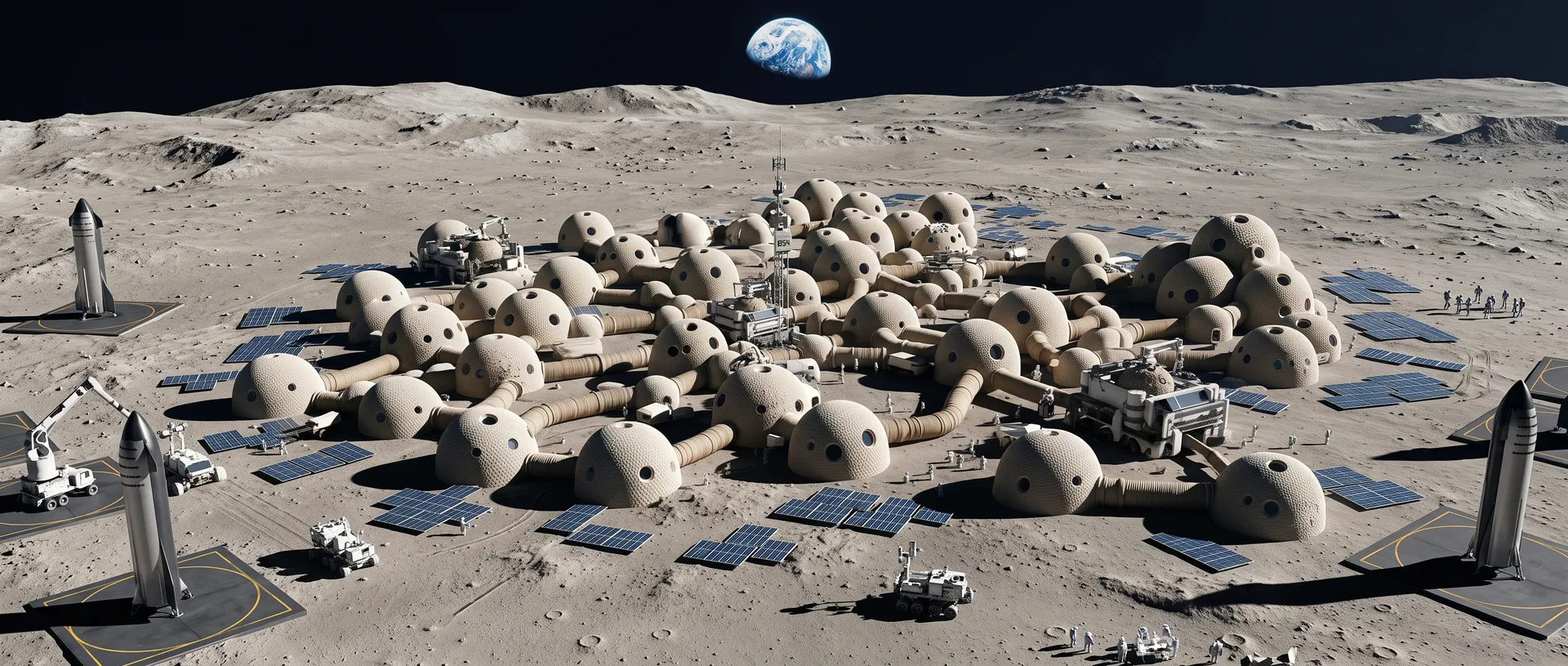
New Space Economy
“Humanity´s most ambitious building project.”
Private space ventures accelerate humanity´s path to the stars. More agile iteration cycles and independent private financing are fundamentally reshaping the space economy."
However, the main bottleneck that blocks humanity´s way to the moon (and the stars) is the immense payload to space. At a launch and landing cost of $1M per kilogram, surface habitat construction is economically viable only through high-degree In-Situ Resource Utilization (ISRU) - the practice of building with local lunar regolith. ISRU means using local lunar regolith for habitat construction.
The best current concepts aim for 60% ISRU.
Thanks to the unique habitat design proposed by our LUNAR HABITATO project, we aim for 80-90% ISRU.
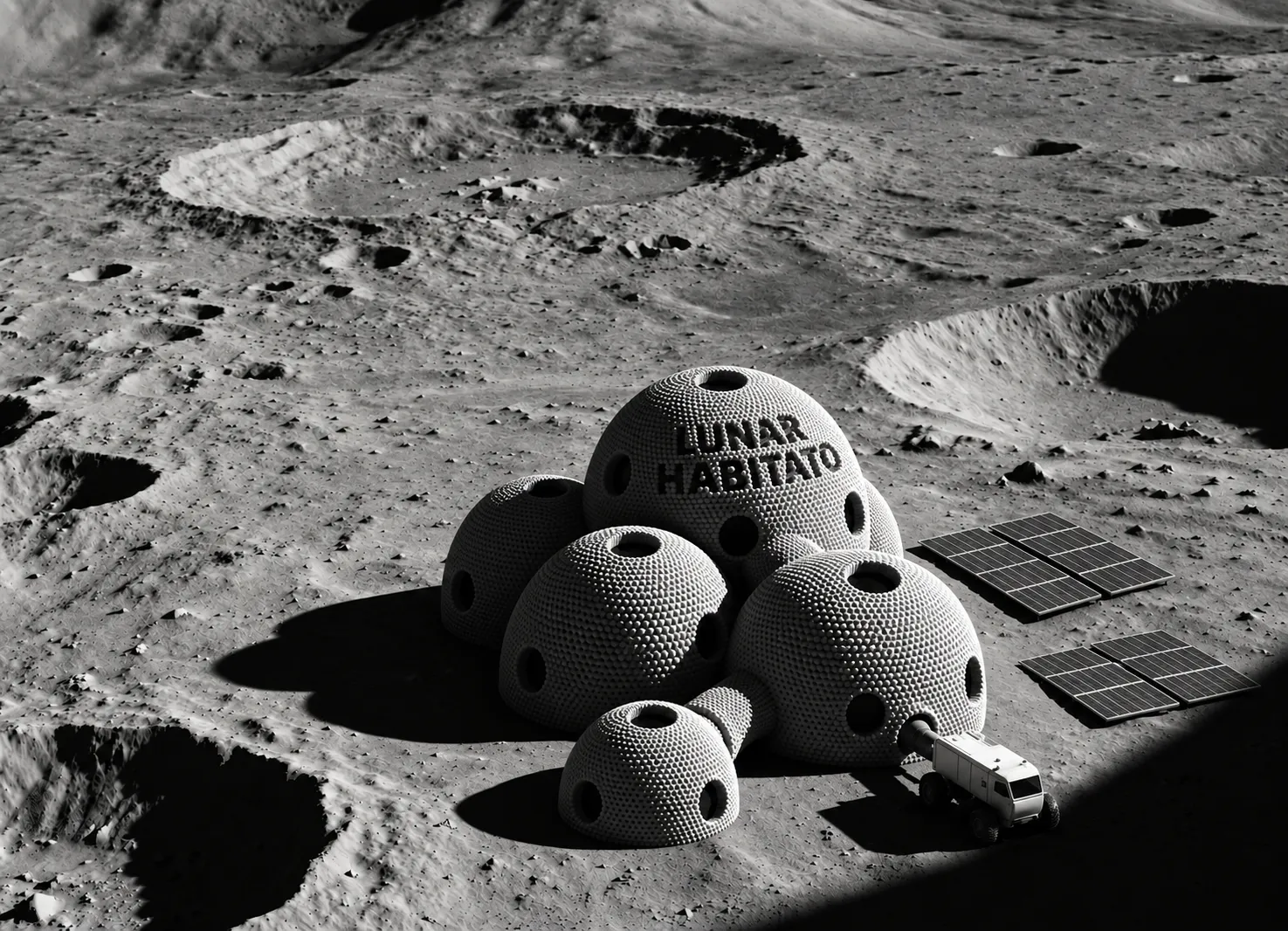
LUNAR HABITATO
LUNAR HABITATO
After founding HABITATO as a 3D printing tiny house concept in 2024, we re-imagined our habitat design for the demands of lunar colonization in 2025.
That was the birth of our Moon habitation project LUNAR HABITATO.
By 2026, LUNAR HABITATO is no space tech rookie anymore.
With three WIPO-registered design IPs for our unique habitat design, two research projects and several LOIs from industrial and research partners, LUNAR HABITATO validates its bold claims constantly.
Rather than aiming for a lunar mission for us, LUNAR HABITATO orchestrates all the relevant space tech innovators and develops a unique deployment mission method. This licensing package will allow to deploy an ultra-resilient, permanent moon habitat for a fraction of our competitor´s budgets.
Enabled by an unparalleled high ISRU degree and semi-autonomous swarm robotics, LUNAR HABITATO paths new ways to the moon and beyond.
Design & IP
“Unique design solutions for unique problems.”
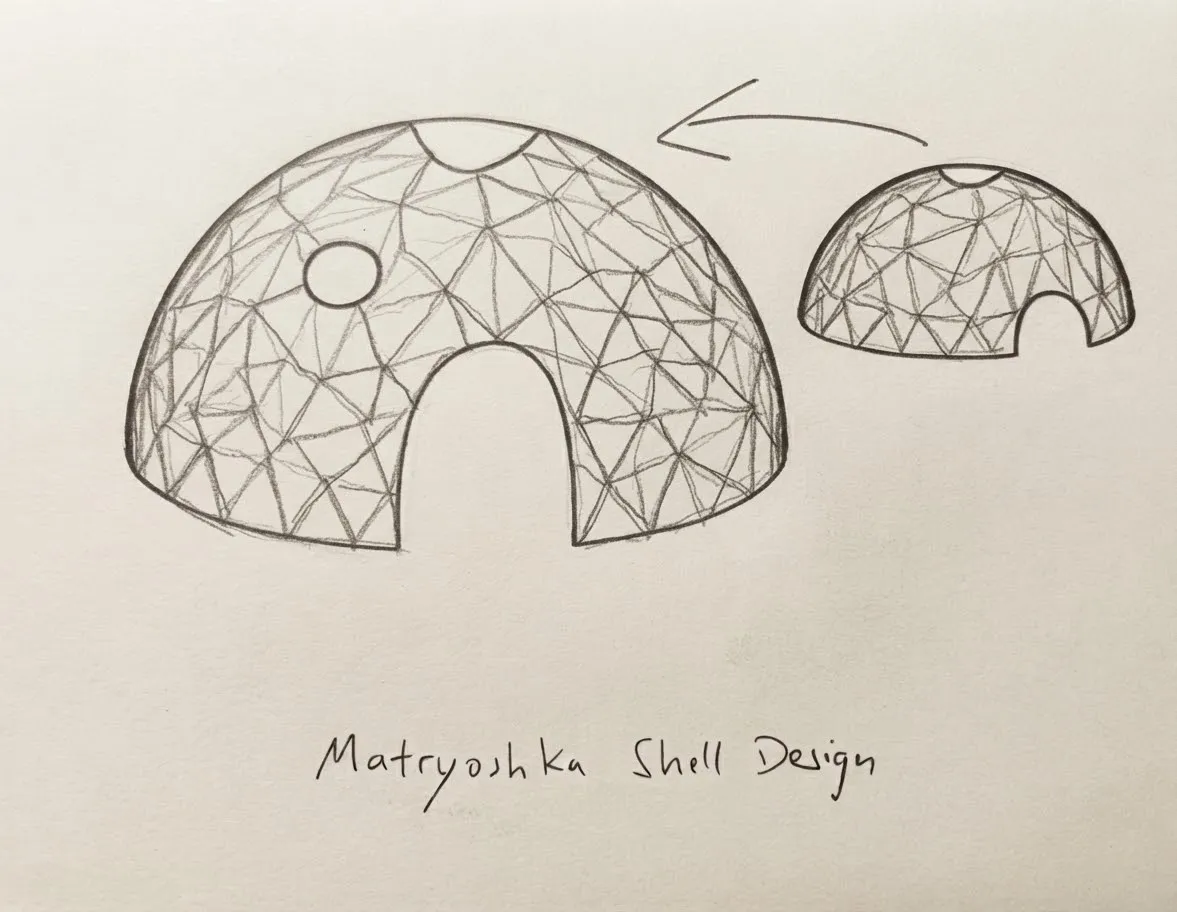
Everybody knows the Matryoshka dolls, the famous Russian nesting dolls.
This unique principle inspired our shell design.
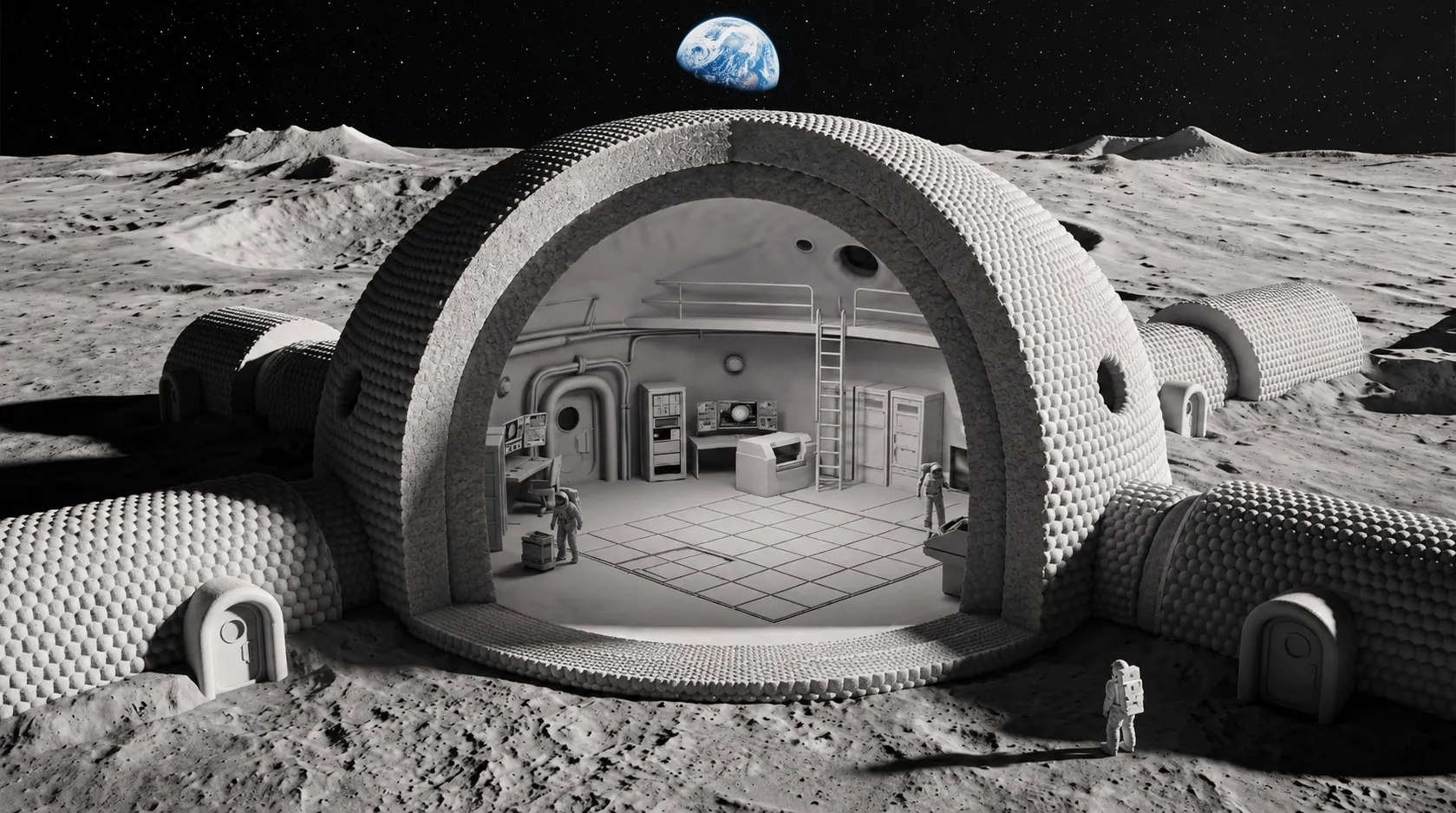
With our three WIPO-registered design IPs we offer new ways to ISRU-based moon habitation. The “Matryoshka Shell Design” (MaSh) provides unparalleled structural integrity and radiation shielding through its double-layered, nested shell design.
But it doesn´t stop there.
By rethinking exterior geometry, we engineered a modular surface solution that maximizes surface area and structural deflection. Our novel knobbed exterior BUG SHIELDS ('Single Armor' & 'Double Armor') - provide enhanced protection against micrometeorite impacts.
“Bring the shovel to the sand. Not the other way around.”
That´s ISRU in a nutshell.
Every percent of gained ISRU degree equals a cost reduction of roughly one billion dollars.
Through our research programs, we demonstrate the feasibility of 80-90% ISRU level and offer a licensing model that reduces overall habitat deployment costs by factors of 100x to 900x.
“Intellectual property. Our most valuable asset.”
Deployment missions are dangerous.
Robots don´t need oxygen, food, or water.
They don´t care about gamma radiation.
So why put the life of astronauts in jeopardy, when robots can do the job?
To address these issues, our IP expands to specific, scientifically validated methodology.
We plan to use brain-computer interfaces to control the semi-autonomous swarm-robotics. The mission controllers will be safe all the time.
Lunar digital twins provide early validation of this particular methodology.
These assets put us in a strong position to establish an innovative lunar habitat design.
Human safety above all!

Researching
“Research projects. The core of our DNA.”
Since 2025 we are involved in several space tech related research projects, such as:
- ESA / Fraunhofer FIT's “ADTLAS” (XR study based on lunar digital twins)
-Politecnico di Torino's and MIT Media Lab's “Swarm-robotics-based shell construction” ASP study.
Early validation:
The data from the midterm report for “ADTLAS” is an early validation for some of our claims regarding ISRU construction methods that use regolith as printing material.
Letters of Intent by:
- WASP (World's Advanced Saving Project): Three cooperation LOIs for lunar regolith printing project
- Fraunhofer FIT granted us an LOI for partnering with any drone company that has the expertise and willingness for joint studies or developments.
- Further Fraunhofer FIT LOIs for research cooperations or industrial partnerships with both mining companies and BCI enterprises are pending.
WASP / ISA study “GLAMS”
In a joint study with the Italian Space Agency, WASP has demonstrated the possibility to gain the binding material for the 3D printing also from regolith, in form of geopolymers. Given that 10% of the habitat weight is binding material, this method alone literally saves a hundred billion Dollars!
FOUNDER´S JOURNAL
"From Tiny Houses to Moon Habitats"
This is my personal journal of our rather unexpected moonshot journey. I am Johannes Lierfeld, I hold two PhDs, writing a third dissertation about ISRU and our LUNAR HABITATO project and I own three WIPO-registered design IPs. Beyond that I love doing strongman and weightlifting, still competing regularly at 49 years old.
So without further ado, let´s just dive into anecdotes and milestones, pushbacks and learnings:
April, 15th, 2025: Bank & Bagels Business Breakfast at the rooftop of Xdeck
Unaware of the plot twist awaiting me, I was attending a business breakfast at the Cologne start-up hub Xdeck. Soon I engaged in a conversation with Jonas, a fellow 3D printing enthusiast, and he asked about our business model. I told Jonas about our vision of 3D printed tiny house domes and showed him some of our visualizations. To my surprise, Jonas told me that the ESA was looking for similar designs for moon habitats, and that I should reach out to them.
At first, I was almost amused at this idea. I imagined that the ESA would reply to my email after two years, when I would have long forgotten that I even contacted them. But later I asked him for his contact, and it showed: this was the right decision. Less than 24 hours after I reached out to the ESA contact I received a call with a very optimistic tone. Shortly after we had developed the first visualizations and delved into the Research & Development in this unknown territory “spacetech”. Soon we got a conference call scheduled where we would pitch our vision to ESA engineers.
May 30th, 2025: ESA calling
The initial contact with the space industry.
Pitching a new idea has always been a thing I enjoyed. But this time, the enthusiasm was on another level. By now, we had the vision of a double-layered habitat design, which we called the “Matryoshka Shell”, inspired by the famous Russian nesting dolls. During the 60 minutes call, one leading ESA engineer repeatedly confirmed that he “didn´t see something like that very often”. To make sure that I understood him correctly, I asked what similar concepts he had seen. He clarified that he hadn't seen anything remotely comparable to our design. A nice early validation of our idea!
The specific design, combined with a strong ISRU approach (“In-Situ Resource Utilization”), put us in a strong position to attend for the next cohort of ESA BIC (Business Incubation Centre) call for applications. Said and done! The next months we prepared for the application. Week by week the ideas added to one another, and the concept matured. I couldn´t wait to turn LUNAR HABITATO into an official ESA project.
August 16th, 2025: A birthday party to remember
One couldn´t make this up: the deadline for the OSIP (“Open Space Innovation Program”) application was exactly my birthday. We planned to start celebrating at 5pm. However, Jonas, Max, and me were still polishing some details, so I was running late for my own party. The first guests had emptied glasses of beer for one hour straight, and the bill was already substantial when we finally arrived. We made the deadline and had a birthday party I won´t forget!
September 11th, 2025: First official ESA pitch
The great day we all worked on for months had finally arrived! After we made the first selection step, we would have to pitch the concept to a consortium of decision makers from ESA, DLR, and Airbus. After a smooth and coherent pitch, the Q&A focused on our envisioned implementation of AI agents. The skepticism regarding agentic AI was surprising for us, to say the least. However, we ended the pitch call in good spirit.
A few weeks later we received the disheartening news that we didn´t make it into the ESA BIC cohort, likely because of the AI strategy. During the pitch, I predicted that agentic AI would become the industry standard within a year - a prediction that quickly proved correct. However - back then, not been selected for the ESA BIC program was a real set-back.
October 21st, 2025: Coffee break with patents
We probably all know days like these: stuck at the hotel, and the laptop charger left at home. How to make the most out of the remaining 18 percent of energy? I was meditating over my coffee when I had a striking idea: what if I would turn the “Matryoshka Shell” into a patent? Quick research with “Gemini” showed two things: there was no moon habitat design remotely like our concept, and it looked like it was indeed patentable.
Then I called my friend Dominic von Proeck, co-founder of successful German AI company “LEADERS OF AI”, who had experience with patenting. He recommended a lawyer who I already met through Dominic a year ago. A few minutes later I had reached out to that lawyer and made an appointment to move forward. My laptop had dropped to 15 percent charged.
That morning I learned a lot about business. First: when you really yearn to move forward, nothing will stop you. Second: lots of good things can happen in very limited time. Third: thinking big is a mandatory prerequisite for success – but that won´t cut it. You must act accordingly, too.
October 30th, 2025: Getting into space tech
Sometimes you need a little luck – but you have to show up anyways. As a coincidence I saw a space tech related event on LinkedIn. The event was scheduled at Fraunhofer FIT's “Schloss Birlinghoven” near Bonn, so it was convenient to get there. Me and my co-founder Richard listened to various talks while anticipating the main keynote, held by Prof. Dr. Valentina Sumini from Polytecnico Torino / MIT Media Lab.
Valentina presented her inflatable habitat design she had developed for ESA's “Argonaut” program. After her talk I approached her with the intro that she and her talk were the reason for me attending the event. I briefly discussed with her what we had developed, and she invited me to join the Fraunhofer group the next day.
Of course I did – and after that morning, I signed the contract for our first industrial partnership! It was a major strategic step, and as often, I realized the relevance of this step only in the aftermath. With one signature, we became partners of an ESA/Fraunhofer FIT research project about lunar digital twins. The data obtained here would validate our own research tremendously, giving us the credibility we need to be taken seriously. Another milestone achieved!
December 8th, 2025: The Summer of ´69
The German AI association had scheduled an event at Campus Tölz, a new facility that had been opened two days prior in the presence of Bavarian politician Markus Söder. Luckily, I was booked as a keynote speaker at the AI event, and I had opted to present our LUNAR HABITATO concept as an example of efficient AI utilization.
During the panels before my keynote, the debaters lamented about the lack of narratives in German pitches, which puts them in stark contrast to American business presentations. Instantly I knew I would win the night – I had a strong emotional narrative to start my five minutes stage time with.
During the summer of '69, my parents had their first date, literally a few days before Neil Armstrong and Buzz Aldrin put their feet on the moon. I talked about my parent´s golden wedding, where I held a laudation and compared their date with a moonshot endeavor like the 1969 Apollo mission: never done before, entering new terrain, with unknown outcomes. Then I bridged this anecdote to the topic of my keynote: The golden wedding was about six months prior to my first contact with ESA, and I had no plans to move into space tech back then. However, due to the accelerating powers of AI usage, I had already two patents pending.
My keynote was very well received and in the aftermath I talked with a headhunter of German Accelerator´s “Start2Group” who recommended us for the US programs offered by his hub. Memorable evening and the kick-off for all the incredible progress we were going to make in 2026!
February 10th, 2026: Patents registered by EUIPO!
March 12th, 2026: Another high-caliber research program
Valentina called me out of the blue and asked me if I was looking for another research project. Of course I was! The topic “shell construction via autonomous swarm robotics” couldn´t fit any better. The academic partners of the project didn´t allow me to think twice: household names as Polytecnico Torino and MIT Media Lab could not be ignored!
We bound forces to create a proposal which was well received and immediately accepted by ASP. A few weeks later the research program had kick-off – and LUNAR HABITATO had obtained its second high-caliber research partnership!
April 25th, 2026: Off to San Francisco!
It was my father´s 80th birthday – but I had to catch the plane!
Sometimes you must make hard decisions. But when you take a closer look, they don´t look that hard anymore. To attend German Accelerator's “Market Discovery” program, I had to get the plane in Frankfurt while the celebration was in full mode. Hyped and highly motivated, I fought my flight anxiety and landed in San Francisco in the evening. At the airport I was picked up by Richard Kayser who was already in town. First stop was the “In & Out Burger”, then we went to the hotel and tested the pool.
Next day was the kick-off for a memorable week. During our welcome dinner we met an experienced business lady who was fascinated by our proposal of a licensing model for moon habitation. Instead of risking a mission on our own, we opted to create a roadmap that demonstrated the feasibility of ISRU-based moon habitation. With the credibility of three design IPs and two international research projects, we experienced something that rarely happened in Germany: enthusiastic listeners who posed the right questions.
During the next days, I was coached to pitch at the “Start-up Grind” conference in Redwood City. A big deal – the event had speakers of the caliber of Ashton Kutcher for instance. The specialty of this pitch was its briefness: the stage time was limited to 60 seconds!
Obviously, the brevity of the pitch forced me to ditch everything non-essential. But it produced another effect: I focused on numbers. The night before the pitch I calculated the total weight of a 100 square meter habitat with three-meter-thick walls. It was roughly 1.000 metric tons! When all this material was brought to the lunar surface, this would cost a staggering one trillion dollars at a payload of one million dollars per kg! In the optimal case of 99,9 percent ISRU construction (when only 1 metric ton of material has to be transported to the lunar surface), this would equal a cost reduction at a factor of thousand! These are numbers investors love to hear.
During the pitch training I realized another thing: it didn´t make sense to me to rush through those 60 seconds, like everyone else did. The urge to squeeze everything into this one minute made all the pitches I heard feel like they were cloned – rushed, unemotional, unconnected with the audience. Hence, I opted to start with a question addressed at the audience:
“Did you know that a moon habitat massive enough to protect astronauts from space radiation and meteorites would cost more than one trillion dollars?”
I answered the question myself:
“Don´t worry – I didn´t know that one year ago either. But now I do – and I know what to do about it.”
Boom! The connection was instantly made. People were listening instead of just sitting there. Afterwards we had lots of conversations with the crowd and a ton of great feedback. The learning from that day was evident: if you want to make a difference, do something different!
June 12th, 2026: Global IP expansion
A tell-tale sign for success is when two milestones come on the same day. This was the case when we expanded our IP to global protection through WIPO registration while I was holding a keynote at Riga university.
July 11th, 2026: San Francisco, Market Access (Immersion Week 1)
Going back to San Francisco bay area felt almost like coming to a second home only 10 weeks after our first appearance in the area.
July 29th, 2026: JP Morgan calling!
At the traditional payload and freight, not even JP Morgan can afford a single 100 sqm moon habitat!
The price for 1.000 metric tons of building material - which is required for a 100 sqm habitat with 3 meter thick nested walls - will be one trillion Dollars! JP Morgan's net worth of roughly 975 billion would come close, but ultimately fall short.
That was my intro into the pitch call with the hard-boiled bank manager. In the aftermath he was pretty well informed about new space and offered to open JP Morgan´s VC network to share our proposal. Couldn´t ask for more!
Partnership
“Let's rethink to make space great again!”
Building a lunar infrastructure cannot be achieved by a singular entity.
New space ventures and traditional space need to bind forces to make the dream of humanity as an interplanetary species a reality.
We see ourselves as catalysts who orchestrate all kind of relevant researching and crucial industry innovators to make our bold vision first a feasible solution and second space industry´s new gold standard for habitat deployment.
Hence, we are not only looking for investors, but for the right partners: industrial partners, research partners, and strategic co-developers.
We look forward to make space great again together!